Monday, April 11, 2011

1921 Pine Castle Directory

In the ongoing effort to transcribe all the Pine Castle records on file in this little corner of heaven, I am pleased to report the completion of the 1921 directory:


CLICK HERE to access the new page.


Note, this was actually excerpted from the much larger directory compiled for Orlando.


It is not perfectly alphabetical. Apparently, the original compiler(s) didn't have access to one of those handy-dandy "SORT" tabs that we have on our modern spreadsheets!


Labels: , , ,

Sunday, April 10, 2011

Pine Castle voter registration index, 1919-21

Picking up on the Pine Castle records transcription project, I have posted an index to the local voter registration book covering the period from 1919 to 1921.

This is an important time frame, because it was the first time that women were allowed to register to vote in federal elections.

To check out the index, click on this link:

1919-21 Pine Castle Voter Registration Index


Labels: , , ,

Saturday, April 09, 2011

Pine Castle history hike

Thanks to intrepid local historian and hiking enthusiast Steve Rajtar for combining those passions as he led this morning's tour of historic Pine Castle!

If not for the frustrating inability of the new iPad2 to accommodate Flash, yours truly would post some of the great shots snapped with said new toy.

In their absence, ye socks shall be left to your own imaginations!

Labels: , , , ,

Friday, April 08, 2011

2 more articles posted

Keeping up with the posting of articles from the 1974 edition of the Pine Castle Pioneer Days magazine. First one is on the Council Oak, which will serve as the iconic image of the 2012 festival. (Plays well into the theme of "roots."). Second one is on the Holden Heights area.

Like most of the articles in the magazine, neither of these gives the author. I can only assume they were penned by the late Ruth Barber Linton . . .

The growing index of the 1974 articles may be found here:

Pioneer Days Magazine Articles

Labels: , ,

Thursday, April 07, 2011

New magazine article posted

Picking up on the Pine Castle digirecords project in this little corner of heaven, I have posted an article about the Conway neighborhood written by Mrs. Eulene Mizell Smith that was originally published in the 1974 edition of the Pioneer Days magazine:

http://freepages.genealogy.rootsweb.ancestry.com/~oldpinecastle/pdmags/1974-early-conway.html

More to come, as time permits!

Labels: , ,

Wednesday, April 06, 2011

Pioneer Days Annual Board Meeting

The executive committee of Pine Castle Pioneer Days, Inc., held it's annual meeting in Orlando this afternoon.

Mostly, this involved the typical year-end "housekeeping," like reviewing/amending bylaws.

But, we also voted in a slate of new board members to help direct the 2012 festival. The new members will be formally installed later this month.

In the mean time, we are still looking for folks who are interested in serving (or chairing) one of the several committees who help to make this important community event happen.

Labels: ,

Friday, April 01, 2011

Missing any socks?

Apologies to ye socks who were accustomed to daily posts in the dryer over the last few years.

Several pressing things in this neck o' the woods kept yours truly from keeping up with regular blog entries.

Mostly, any spare time that I might otherwise have been able to devote to improvement of the blogosphere was consumed by the massive planning and staging of the 2011 Pine Castle Pioneer Days festival.

For more info on that, check out the event site at http://www.pinecastlepioneerdays.org or join or Facebook group. (LOTS of great new photos are posted on the latter.)

At any rate, I took another month to recover from Pioneer Days before making the commitment to getting back to The Sock in the Dryer.

Labels: , ,

Friday, October 29, 2010

Silent Auction Nov 4th - List of items up for bid


Labels: , ,

Thursday, October 21, 2010

Remember Third Thursdays at Chick-fil-A!

Just a quick reminder to ye socks that both South Orlando locations of Chick-fil-A will be donating all proceeds from sales made between 5pm and 8pm this and every "Third Thursday" to Pine Castle Pioneer Days.

Make sure to tell your order-taker that you are a Pioneer Days supporter so we get credit for your sales!

http://pinecastlepioneerdays.org

Labels: , ,

Wednesday, October 06, 2010

Pioneer Days general planning session

As a reminder, Pine Castle Pioneer Days holds its general planning session on the first Wednesday of every month.

So, yep, it's that time again!

If you want to get involved in planning the next festival, show up at 3pm today at Belle Isle City Hall (1600 Nela Avenue).

Or, you can visit the festival website at: http://pinecastlepioneerdays.org/

Labels: , ,

Wednesday, September 29, 2010

Pioneer Days finance committee meeting

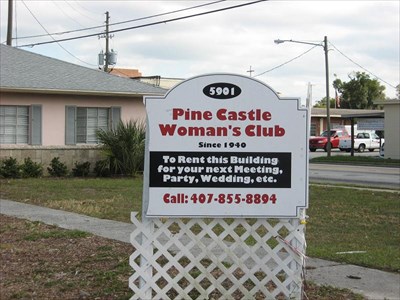
Thanks to the ladies at Pine Castle Woman's Club for hosting our finance committee meeting today!

They have been a community institution for 70 years.

If any of ye socks are interested in renting their clubhouse for any upcoming event(s), give them a call at 407-855-8894.

Thanks again, ladies!

Labels: ,

Sunday, September 12, 2010

Pine Castle Historical Markers - part 10

THE TRAIN STOP

The South Florida Railroad came to Pine Castle in 1881, connecting Orlando and Kissimmee with two trains a day. A trip to Orlando cost 15 cents, and the train made three stops along the way, unless additional stops had to be made for the occasional alligator or cow that had wandered upon the tracks. As the local citrus industry grew, growers found it convenient to ship fruit from the Pine Castle station.

The coming of the railroad speeded up mail delivery. Outgoing mail was put in mailbags and hooked onto a pole and picked up as the train went by, and incoming mail was thrown from the train onto a platform near the station depot.

In 1893, the Plant System purchased the South Florida Railroad and in 1902, the Atlantic Coast Line Railroad acquired the Plant System. In 1967 the latter railroad merged into the Seaboard Coast Line Railroad which eventually passed to CSX. Although trains no longer stop in Pine Castle, freight and Amtrak trains still pass through daily.

Labels: , ,

Saturday, September 11, 2010

Pine Castle Historical Markers - part 9

UNION CHURCH

The first church in the Pine Castle area was established on the shores of Lake Jessamine in 1876, by local Presbyterians. But, this congregation later merged with First Presbyterian Church of Orlando, and their building was put to other use. Other early denominations met in the homes of members.

In 1900, a need for an interdenominational church building in Pine Castle motivated local women to organize the Christian Workers Society, raise money for the building, and help the needy. The group sponsored ice cream socials, oyster stew dinners, and box suppers. Men in the community contributed to the project by cutting timber and hauling logs to the nearest saw mill at Smithville (now Taft). Once the logs were cured, they built the Union Church on the northeast corner of South Orange Avenue and Wallace Street.

On alternating Sundays, ministers came from Orlando and elsewhere to conduct Methodist, Baptist, and Missionary Alliance services. The small congregations generally attended each others services. It was not unusual for a minister to start shouting during a service in order to be heard over a passing train.

In 1910, a parish house was built behind the church that was used not only for Sunday school, but also for entertainment and other community gatherings. The church property was deeded to Methodist-Episcopal Church South in 1930. At the end of the 1950s, the building was moved to State Road 15A, north of Narcoossee near Lake Whippoorwill, in order to be used as a Baptist mission.

Labels: , , ,

Friday, September 10, 2010

Pine Castle Historical Markers - part 8

DIXIE HIGHWAY

This section of Orange Avenue was a part of the Dixie Highway, the first road connecting the North to the South. It opened in October 1925, and travelers could begin at the northern border of Michigan and journey to Miami, Florida. So many cities wanted to have the roadway that the Dixie Highway grew into a vine-like network of interconnected paved roads rather than a single thoroughfare, each identified by the simple signage of white DH letters on a red background.

In Florida, the route passed through Tallahassee and Jacksonville and proceeded south along the East Coast. Lobbying produced an additional inland route passing through Gainesville, Ocala, Winter Park, Orlando, Kissimmee, Bartow, and Acadia, rejoining the coastal route at Palm Beach. The paving of the Dixie Highway from Sanford to Kissimmee in 1916 put Pine Castle on the country’s primary north-south road until US 441 was built two miles to the west in the 1930s. It became the main route and also was known locally as State Road 2 and Black Bear Trail.

Labels: , ,

Thursday, September 09, 2010

Pine Castle Historical Markers - part 7

PINE CASTLE

Will Wallace Harney came to Florida in 1869 seeking a better climate for his wife’s health. He purchased a 160-acre homestead on the western side of Lake Conway and called the grand home he built Pine Castle. The village that developed near his property adopted the name and, on December 8, 1879, the post office was officially established. Harney subdivided his property, and from 1880-1895, Pine Castle appeared on the Orange County planning map as a new development.

More than 300 people lived in Pine Castle in the early 1920s, and some residents wanted it incorporated during this boom period. During the planning stages, it became evident that different groups of residents had different visions for the town. As a result, three separate towns were organized: Belle Isle, Edgewood, and Pine Castle. But when the real estate market crashed later in the decade, they had difficulty sustaining their tax bases. Incorporated in February 1925, Pine Castle’s government ended in 1929. With its charter dissolved, it became an unincorporated part of Orange County.

Labels: , , , , , ,

Wednesday, September 08, 2010

Pine Castle Historical Markers - part 6

CORRECT CRAFT

In 1925, Walter C. Meloon moved his family from New Hampshire to Pine Castle and started the Florida Variety Boat Company with two other partners. The building, located on the southeast corner of Randolph and Hoffner Avenues, was constructed with blocks that once housed the old theater and later the water works plant. In 1930, Meloon became the sole owner and changed the name of the company to Pine Castle Boat and Construction Company. Eight years later, the company became known as Correct Craft. When the company needed more space, it moved to Orange Avenue.

During World War II, the army asked the Meloons to build storm boats capable of crossing the treacherous Rhine River, Germany’s last natural line of defense in the West. For a company that normally built forty-eight boats a month, the government’s request for 300 boats in three weeks seemed impossible. Yet, the boat builders not only fulfilled the contract, but also made 100 boats to spare. The family-owned business, operated from the same location until June 2006, when its need for expansion forced the company to move to East Orange County.

Labels: , , ,

Tuesday, September 07, 2010

Pine Castle Historical Markers - part 5

PINE CASTLE SCHOOLS

Early education in the new community of Pine Castle was carried out casually, often in someone’s home, but Orange County established a formal school district in 1869. A school had to have a minimum of 10 students to receive county funds. Pine Castle’s first school, a rough-hewn structure, was built in 1877 on the corner of Orange and Hoffner Avenues. Textbooks were donated by Will Wallace Harney.

The first teacher was Mrs. Jennie Preston (1831-1904), the namesake for nearby Lake Jennie Jewell. Teacher salaries were dependent upon daily average attendance and could be increased or decreased by the school board according to the average that had to be certified each month. For the 1888-1889 school year, the county paid Pine Castle salaries totaling $33.00.

In the 1880s, a new school building was built on the northern part of the present school grounds, and it also was of similar design, containing rough desks and seats.

In 1900, a new school on the same grounds was constructed of finished lumber and had louvered shutters at its windows, and by 1912, an increase in the student population resulted in the building of a two-story building.

An additional school, a two-story stucco building, was built in 1924, during Pine Castle’s boom years. Expansion continued with the addition of new buildings, including an auditorium. By 1952, the school could only be used for elementary students while older students were transported to other Orange County schools.

Labels: , ,

Monday, September 06, 2010

Pine Castle Historical Markers - part 4

CONWAY CHAIN OF LAKES

Native Americans called the region surrounding the Conway chain of lakes as “Okehitanatchee,” translated as “land of fair waters.” In 1843, Benjamin Whitner of nearby Mellonville was awarded a contract to survey lands in this vicinity, and named Lake Conway for his superior Valentine Yelverton Conway, Surveyor General of Florida. Until development and drainage changes in the 1900s, seasonal rains transformed the Conway chain into one big lake. Now Hoffner Avenue divides North and Middle Lake Conway, and Nela Avenue divides Middle and Little Lake Conway.

Early settlers used the lake for drinking water, bathing, food, and entertainment. Prominent Orlando citizens such as the Dickson family of Dickson and Ives Department Store had summer homes on the lake where they came to fish and swim.

Crittenden Dock was located where Randolph Avenue, a road Will Wallace Harney named for his wife’s family, dead ends at Lake Conway. It has long been a favorite recreation spot, and as early as 1882 guests at the adjacent Macy Hotel used it to launch pleasure cruises and fishing expeditions. The Crittenden family acquired the site and built a dock that was popular with swimmers and boaters. In 2000, Charles and Pearl Crittenden deeded the property to Orange County for use as a public boat ramp.

Labels: , , ,

Sunday, September 05, 2010

Pine Castle Historical Markers - part 3

MACY HOTEL

William H. Macy (1819-1903) came to this area as a government surveyor in the years immediately following the Civil War, and was elected to the Orlando city council in 1878. An engineer by training, he followed the rail lines south to the Pine Castle area and opened a blacksmith shop west of the tracks. This shop served as the town’s first Sunday School meeting place until it burned in 1884.

His wife Martha J. Macy (1835-1906) acquired 10 acres of Will Wallace Harney’s original homestead lands, which later encompassed the site of the modern First Baptist Church of Pine Castle. Here, Mrs. Macy operated the town’s first hotel, with many of her guests brought from Orlando by “Macy Wagons” built by her stepson George Macy. After the railroad arrived in 1881, visitors also arrived by train at the nearby South Florida Railroad depot.

In 1894, Mrs. Macy deeded a half-acre of the hotel land at what is now the northeast corner of Randolph Avenue and Hoffner Road to the local Baptist congregation. Though now paved over, it is believed that she and other family members were buried there.

Labels: , , , ,

Saturday, September 04, 2010

Pine Castle Historical Markers - part 2

PLEASURE BEACH

Wallace Road was named by Pine Castle founder Will Wallace Harney for his mother’s family. The point where the road dead-ends at Lake Conway became known as “Pleasure Beach,” and was a popular gathering place for area residents, especially in the 1920s. Church, school, and family picnics were held on the shore, and the Union Church used the lake water for baptisms. There was a long dock containing park-like benches and at the end, low and high diving boards and a water slide. Canoes were available for rides around the lake.

The nearby pavilion contained a bath house on the first floor and a place for dancing and skating upstairs. Slot machines were installed, drawing people from as far away as Windermere and Apopka to gamble. The pavilion burned in the late 1920s, but the dock and beach continued to be used by the public. In the 1940s, a family built a home on the property and closed the beach to the public.

Labels: , , ,