Wednesday, June 09, 2010

Read the book first!

So, the latest DVD delivered to this little corner of heaven by the friendly folks at Netflix was the adaptation of Audrey Niffenegger's recent best-selling novel "The Time Traveler's Wife."

I read the book about a year ago or so, and enjoyed it. Not only did it have an interesting premise, but it made a pretty powerful statement about the eternal nature of certain interpersonal relations.

Too heavy for ye socks?

Well, the movie version isn't heavy at all.

In fact, I would guess that anyone who hadn't read the book in advance would think the film adaptation is more than a bit contrived.

Bottom line: if you're gonna watch the movie, read the book first.

Labels: ,

Saturday, May 08, 2010

"The Conquerors," by Thomas B. Costain

This first volume in Costain's masterpiece trilogy spans (roughly) the years from the Norman Conquest to the Magna Carta: 1066 to 1215.

His writing strikes a middle course, between the dry footnote-laden scholarly tomes that are a turn-off to the average reader and the all-too-popular romanticized versions of medieval royalty churned out by the purveyors of pulp fiction. He knows how to tell a good tale, weaving what might otherwise be bland historical names, dates, and facts into a compellingly cohesive narrative.

But, the real beauty of it all is that it does not depend on any embellishments. In fact, Costain dispels many of the myths and legends that persist about this important era in the history of the English-speaking world, often deciphering the grain(s) of truth hidden within the legends:

  • William Conqueror is more than just an invading bastard.
  • His son Henry I isn't quite the "beauclerc" his nickname suggests, producing a document that would forever curb the power of the crown.
  • Eleanor of Aquitaine played no part in the death of "Fair Rosamunde."
  • Richard the Lion-heart was indeed a great warrior, but a miserable failure as a king.

My one criticism of this work is that it is dated (1949), and bowed to many of the sensitivities of the era in which it was written. For example, one really must read between the lines about the poor treatment Berengaria of Navarre received. Still, Costain's readable prose proves his argument that the century and a half following the Battle of Hastings forged the Normans and Saxons into a single nation.

Bottom line: Good read if history is your thing.

Labels: , ,

Saturday, February 06, 2010

A Painted House

While yours truly awaits the arrival of the books mentioned in last weekend's post, the page turner in our humble abode these last few days has been John Grisham's 2001 novel "A Painted House."

I bought it when it was new and read a couple of chapters before the events of that year got me off my reading routine.

Anyway, I rediscovered it this week, retrieving it from the attic bookshelf to find it was not hard to get re-immersed in the narrative.

This book represented a departure for Grisham, in that it is NOT a formulaic legal "thriller."

Still, he doesn't exactly stretch himself. The book is set in the rural South of his childhood, and seems at times like a very thinly veiled autobiography.

It tells the story of struggling cotton farmers in the Mississippi Delta region of Arkansas, from the point of view of a 7-year-old boy; and was later adapted as a made-for-TV movie. (No, I didn't watch it.)

It would appear from this (and more recent writings) that Mr. Grisham has some Faulknerian aspirations--at the very least. He also makes an outright reference to an even earlier icon of Southern literature, Tom Sawyer's white-washed fence. It must be frustrating for such a talented writer to be (forever?) pigeon-holed in the legal thriller genre. At least he can be frustrated and rich, no?!?

Anyway, it made for a quick and entertaining read, a good "filler" until those other books arrive . . .

Labels: ,

Wednesday, December 02, 2009

Of Michener and his Chesapeake

So, yours truly managed to pick up a first edition of this book for a few shekels recently.

I found it to be very typical of Michener.

His detractors will try to tell you that his formulaic writing style and lack of character development made the late author nothing short of a hack.

Indeed, I found this best-seller from 1978 to be very much like the other two Michener novels I've read.

And, as he covers nearly four centuries over 865 pages, the folks who populate his narrative are painted in very broad strokes.

Still, Michener fans will argue that his novels transcend these flaws.

They have a point.

If the reader will forgive the uninspired structure and lack of identification he allows (either with would-be heroes or villains), one can put down a Michener novel feeling that they truly know the spirit or character of a given place.

This is certainly true of "Chesapeake."

Labels: , , ,

Wednesday, October 28, 2009

Watchman Nee

That's the Anglicized name of a Chinese man who was born Ni Tuo-sheng in 1903.

He made the change after being converted to Christianity by an English missionary.

And, apparently, he wrote a lot of books about his new-found religion.

A buddy of mine gave me a copy of the first chapter of one of those books, "The Normal Christian Church Life," as supplementary reading material as we plow thru the Book of Romans.

I can't say that I'm a big fan of his writing style. It took him an entire chapter to relate a concept that I'm pretty sure could be just as effective if condensed down to a single paragraph.

I think I'll just stick to reading what St. Paul had to say . . .

Labels: , , ,

Monday, July 06, 2009

Ford should give Emerson a rest

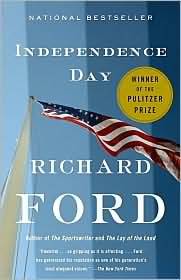
Well, ye socks, yours truly has finally finished reading Richard Ford's prize-winning novel Independence Day.

Kinda appropriate given the recent holiday, no?

Well, as alluded to in a previous post, it took a lot of effort on my part to get thru this one.

Ford's writing is often disjointed. The best dialogues . . . even monologues . . . are delivered over the phone or answering machines.

It's very hard to like any of these characters.

What's harder to like is Ford's fawning over Ralph Waldo Emerson (1803-1882). But, I suppose any apologist for the "great" Transcendentalist is doomed to pratfalls.

Ultimately, Ford suffers the same assessment as his hero, in that he was quite appealing in his youth. But, with age, he became a godless curmudgeon.

I remember thinking a lot of Emerson as a young conservative college student, for a couple of reasons. First, he had a personal connection to Florida, spending his winters in St. Augustine socializing with exiled members of the French imperial family. More importantly, his writings encouraged self-reliance, championed individualism, and dared to see opportunities in adverse situations. He inspired an entire generation of Americans, who deemed his 1837 speech "The American Scholar" to be an "Intellectual Declaration of Independence."

I suppose that's where Ford got the title for this tedious novel, moreso than its actual setting.

Ford was much less-contrived in the prequel The Sportswriter, which somehow managed to speak to me using the same protagonist but with less Transcendentalist clap-trap.

Self-reliance can indeed be a virtue, unless it is taken to extremes. Emerson was an extremist in that he saw no higher power than the individual, and ultimately rejected God. Henry Ware, Jr., pegged him (quite appropriately) for "taking away the father of the Universe" and leaving "but a company of children in an orphan asylum."

This older, bitter, godless Emerson is the figure Ford emulates and celebrates in Independence Day. If ye socks would believe the Pulitzer committee, he evidently succeeded in the former. But, the latter seems more than a bit contrary . . .

Bottom line: skip it.

Labels: , , , ,

Friday, June 19, 2009

Benjamin Button

Oh, how times have changed! Nowadays, Friday nights involve watching the latest from Netflix. But, I suppose it's just as well.

Tonight's feature was last year's best picture, according to the folks over at the Academy Awards. And, I suppose, they know what they're talking about.

But, did ye socks know "The Curious Case of Benjamin Button" is an adaptation of an old F. Scott FitzGerald short story?

Yep, it was. Written back in 1921.

I don't often say this, but the film is better than the book . . . er short story . . . in this case.

The original kicked off in Baltimore back in 1860, with a baby born speaking perfect English and sporting a long white beard.

The film version, however, is set in New Orleans, and begins with a victory celebration following the First World War. Also, the curious newborn neither speaks nor sports a beard.

The overarching theme, however, is the same . . . just better related on screen than in FitzGerald's prose.

Check it out for yourselves, and have a good weekend!

Labels: ,

Wednesday, June 17, 2009

Independence Day

No, I haven't skipped forward a few weeks on ye olde calendar. Rather, that's the title of a Richard Ford novel I started this evening in my ongoing quest to read all the Pulitzer Prize winners.

This one won the prize back in 1996.

It centers on Frank Bascombe, a middle aged former sportswriter turned real estate agent in the town of Haddam, New Jersey.

I have to admit, it's a little tedious so far.

Maybe, it's just my impatience with middle aged angst, regrets, and what-ifs.

Ford . . . or, rather Bascombe, though I believe the two are one in the same . . . seems particularly concerned about permanently boxing himself in, thus questions every decision he's every made or is in the process of making.

Hope this thing turns around . . . soon . . . or it's gonna take me til July 4th to finish it!

Labels:

Tuesday, June 16, 2009

Whaddaya mean you've never heard of Bloomsday before?!?

OK, ye socks, it's June 16th. We all know what that means, right?!

No?

Well, don't be ashamed if that was your answer.

Apparently, yours truly belongs to a more obscure subculture than he thought.

I mean, I guess in the age of the DVD and cell phone, fewer and fewer folks are sticking their noses in James Joyce novels.

But, come on, people! Pick up a copy of Ulysses between now and next 06/16, so you'll have an excuse to party like an Irishman on more than just St. Patrick's Day!!

Labels: , , ,

Tuesday, May 19, 2009

2 summer reading suggestions

One of the joys of vacation, at least for yours truly, is the time it allows you to catch up on your leisure reading.

I have to admit I had a glut of books stacked up in the home office lately, waiting for me to get around to them.

Well, I finally finished two of 'em, one fiction and one non-fiction.

The first was The Brief Wondrous Life of Oscar Wao, which won Junot Diaz a Pulitzer Prize for fiction last year. It is the story of a Dominican kid struggling to overcome an ancient family curse. Diaz peppers the story with amusing and edifying footnotes on Dominican history. While the book does have some dark themes, it is not one ye socks are likely to read and forget.

The second was Outliers, by pop sociologist Malcolm Gladwell, who presents some interesting theories on why certain people achieve amazing successes while others are doomed to failure. He peppers his arguments with great statistics and anecdotes that will really get you thinking. But, what I liked most about it was how Gladwell tied everything back to his own Jamaican ancestry in the last chapter.

So, if you're trying to put together your own summer reading lists in time for the upcoming Memorial Day weekend, consider adding one or both of these books. You won't be disappointed!

Labels:

Friday, May 01, 2009

Olive Kitteridge

The latest title to fall in my ongoing quest to read all the Pulitzer Prize winners for fiction is actually the newest one on the list.

Elizabeth Strout's novel Olive Kitteridge was just announced a few weeks ago.

It's actually more of a collection of 13 different stories, all of which can stand alone. The unifying element is the title character, who appears (to varying degrees) in each one of these tales about the people who live in the fictional town of Crosby on the coast of Maine.

This book definitely deserves all the accolades it has been receiving.

The only bit of negative criticism I have is that it has a very *CROWDED* cast of characters--105 names by my count.

Fortunately, Olive stands out from that crowd. To be honest, though, she's not very likeable in the first few pages. Dare I say she comes off as a foul-mouthed harpy? No?

Well, just as with the real characters ye socks no doubt encounter on a daily basis, Olive does eventually evoke some sympathy--if not actual admiration--as more aspects of her personality are revealed. At the end of the book, she remains a very flawed human being, but the reader is willing to forgive those flaws after 13 tales explain why she cannot be defined in two-dimensional terms.

Definitely worth the read. Check it out for yourselves.

Labels:

Monday, April 13, 2009

Oh, how times have changed . . .

There was a time (not SO long ago) when the birthday of yours truly was celebrated in a much more Bohemian style.

But, today, the highlight was coming home to a nice, quiet house; putting my feet up on the Ottoman; eating a ham and Provolone "sammich"; and watching 24.

And, in between commercials, I began perusing my favorite birthday present, the book "The Next 100 Years," by George Friedman. Although I've just begun to delve into his prognostications, I am already enjoying it. He makes some pretty astute observations, and has already made me view some recent world events in a different light.

Ah, well, time for this old man to head off to bed . . . tomorrow promises leftover birthday cake for breakfast!!

Labels: , ,

Monday, March 30, 2009

Jai Ho!

So, I'm still catching-up on my DVD "to watch" list.

Tonight's feature was the big Academy Award winner "Slum Dog Millionaire."

As usual, I had already read the book. But, not per usual, I cannot say the book was better than the film adaptation. Rather, both are good for different reasons.

For ye socks who haven't picked up the book (originally entitled "Q&A," by Vikas Swarup), here are the differences:

1. The main character in the movie is named Jamal and is identified as a Muslim. In the book, he is called Ram Mohammed Thomas (Hindu, Muslim, and Christian names) and his ethnic/religious background is ambiguous.

2. In the movie, Jamal's mother is killed during a Hindu lynching of Muslims in the slum. In the book, he never knew his mother. She abandoned him at birth to be raised by a Catholic priest.

3. In the movie, Jamal's brother Salim plays a key role in advancing the plot. In the book, Salim is only his best friend.

4. In the movie, Jamal's love interest is Latika, who is also orphaned in the aforementioned lynching. In the book, the love interest is a prostitute that doesn't appear until the main character is a teenager.

I kinda liked the adaptation's linkage of the three main characters, tying them together with the "three musketeers" and the final question on the quiz show.

But, check it out for yourselves, and let me know what YOU think!

Labels: ,

Saturday, March 21, 2009

The Road, by Cormac McCarthy

Well, ye socks, I just got done reading the latest tome in my checklist of recent Pulitzer Prize winners.

This one won the prize for fiction in 2006.

But, be forewarned. It is not one of those fuzzy, feel-good novels that lets the reader escape into a pleasant alternate reality.

Instead, the post-apocalyptic world presented by El Paso writer Cormac McCarthy offers only a bitterly cold landscape, covered in soot and ravaged by the cannabilistic survivors of some great calamity.

He never really defines what exactly that calamity was. It isn't important, as McCarthy's true intent is the cautionary tale that springs-up in its wake--one of a man and his son journeying along a nameless road that gave this novel its simple title.

McCarthy peppers the tale with symbolism. Some of the images are likely to become indelibly etched in the reader's mind. Hopefully, some of the wisdom will, too.

Bottom line: not an easy read, but worth it.

Labels:

Friday, March 06, 2009

The Hemingses of Monticello: An American Family

That's the title of a book [ISBN 9780393064773] by Annette Gordon-Reed that the Orange County Library System was kind enough to deliver to yours truly this afternoon.

I had seen the author on a recent talk show, which sparked my interest. She's a smart cookie, teaching both law at NYU and history at Rutgers. And, I figured any work that wins a National Book Award is worthy of a perusal. Besides, the whole genealogy angle is always appealing to me.

Though I am only just beginning to delve into it, I have not been disappointed so far. Gordon-Reed writes in a style that is easily followed, and cites her sources in a way that would make any English teacher proud.

Before I began reading, I couldn't help myself but check out all the illustrations inserted in between the pages near the middle of the book. Often times, pictures do indeed say a thousand words and offer the best prelude to a lengthy text like this.

Imagine my surpise (and discomfort) to discover the third illustration of the accounting of a slave sale dated 30 December 1772 included my own ancestor Richard Stith among the list of buyers of human chattel.

Clearly, this book's subject matter is going to be as challenging to this descendant of slaveowners to read as it must have been for the descendant of slaves to compile.

Fortunately, I'm always up to a good challenge . . .

Labels: , , , , , , ,

Sunday, February 22, 2009

Land of Marvels, by Barry Unsworth

Well, ye socks, I just finished this novel about pre-WWI Iraq.

And, I struggled to get thru it.

Basically, it's the tale of a British archaeologist named John Somerville who is running out of time in his quest to unearth an ancient tomb in the Mesopotamian desert.

He has to contend both with an advancing German railroad that threatens to lay its tracks right thru the excavation site, and with violent competing oil interests.

Sounds like exciting stuff, right.

Wrong.

Unsworth's writing style is like a car with a bad transmission. There's a lot of higgety-jerk. Parts of it read fast, and advance the plot line(s). But, other parts are slow--full of excruciating details that simply are not as fascinating as he evidently thinks they are and do nothing to develop his nearly-one-dimensional characters.

In fact, I didn't care a whit that four of the main characters were vaporized at the end of this arduous tale.

Save your time and weary eyes, and leave this book on the shelf.

Labels:

Sunday, February 08, 2009

The Devil's Brood

That's the title of Sharon Kay Penman's final installment of her trilogy on Henry II and Eleanor of Aquitaine.

I have always enjoyed Penman's work. She has a unique ability to reanimate historic figures. And, the dysfunctional Angevin royal family were perfect fodder.

Some of ye socks may remember something of the saga from watching the classic 1969 film "The Lion in Winter," with Peter O'Toole, Katherine Hepburn, and Anthony Hopkins, in Mrs. Duncan's senior English class.

Penman has the advantage over the screenplay, though. After reading her version of this tangled saga of conspiracy and betrayal, you feel like you actually "know" the characters. This is particularly fascinating stuff if, like yours truly, you can trace your family line back to this period and these people.

I was surprised towards the end of the book, when I caught myself laughing out loud at Penman's account of King Henry's deathbed conversion. Not the sort of subject material that generally makes one laugh, right?

Well, in this case, the stubborn king lay on his deathbed bitterly refusing to reconcile himself with God, feeling He had foresaken his family. But, then, one of his household knights whispered something in his ear. And, Henry quickly ordered his servants to carry him to the nearest church to receive absolution.

Stunned at the quick turn around in the king's attitude, the other knights asked their comrade what he had whispered in his ear. His answer? He had simply remarked if the king went to hell an unrepentant sinner, he would have to spend all eternity with with his equally unrepentant sons!

If you like historical fiction, give this one a chance. And, if you like it, check out Sharon Kay Penman's other works on her website:

http://www.sharonkaypenman.com

Labels: , , ,

Sunday, December 07, 2008

The Christmas Sweater

That's the title of Glenn Beck's first attempt at novel writing.

I got it in the mail from the library on Friday as a hold-over until that vampire book arrives . . .

Anyway, I finally got around to taking a look at it today, and it was a quick and easy read.

Of course, that is the very justifiable criticism that has been leveled against this book: It is too predictable and sentimental.

But, I suppose those are a couple of things we look for during the holiday season.

Beck reveals in the end that this tale is based on his own childhood, which added some weight to the parable. But, not much.

Still, if you don't have a good vampire book to sink your teeth into . . . I know, bad pun.

I hope ye socks enjoy the remains of your weekend!

Labels:

Monday, December 01, 2008

Calling all bibliophiles!

What should I read next?!

I just finished Mike Huckabee's new book Do the Right Thing. (An excellent--if bittersweet--rehash of his recent run for the presidency . . . he should've been the GOP nominee, but that's another story . . .)

Anyway, I now find myself bookless and decided to let ye socks choose what I should read next. Let me know either by posting here or by private email or otherwise by Friday.

Here's the list of candidates:

* Cover her Face, by P.D. James (1962) first in a series of British mysteries.
* The Camel Club, by David Baldacci, first in a series of political thrillers.
* Too Fat to Fish, by Artie Lange from the Howard Stern Show.
* American Lion, by Jon Meacham, historical work about Andrew Jackson.
* The Shack, by William P. Young, a self-published Christian novel that became a bestseller.
* The Appeal, by John Grisham, his first lawyer fiction book in years.
* The Secret Life of Bees, by Sue Monk Kidd, almost deleted this one for getting Oprah's nod.
* The Alchemist, by Paulo Coelho (1988), Portuguese story translated into 60+ languages.
* Dead Until Dark, by Charlaine Harris, first in a series of Southern vampire stories.

Let me know what you think!

Labels: , ,

Thursday, November 20, 2008

For the love of Ireland

The 10th edition of the Carnival of Irish History and Culture encouraged bloggers to post on some aspect of Ireland that they particularly love.

I chose Irish literature because the emerald isle has produced so many great writers over so many generations, whose works both transcend time and push the boundaries of the written word as an artform.

Consider a few of these geniuses.

You can look all the way back to Jonathan Swift, who introduced us to Lemuel Gulliver and his travels to Lilliput and beyond.

James Joyce can put your brain thru a wringer with his stream of consciousness and multi-level puns. If you don't believe me, check out Finnegan's Wake.

Or, if you're really looking for a mind-bender, try anything by Samuel Beckett.

Roddy Doyle, a modern playwright, has had his works translated to the big screen. Remember "The Commitments," about the bunch of Irish soul singers?

He's not nearly as controversial as John Millington Synge was "back in the day," though. His work "The Playboy of the Western World" actually sparked riots in Ireland!

I love the moxy of Nobel laureate Seamus Heaney, who so objected to being included in an anthology of British writers that he composed this couplet: "Be advised, my passport's green. No glass of ours was ever raised to toast the Queen!"

Of course, everyone on this side of the Atlantic has heard of Frank McCourt, the living legend whose work Angela's Ashes is rightfully taught in our public schools.

And, don't forget Lady Gregory, whose motto should be the vow of all writers: "To think like a wise man, but to express oneself like the common people."

I'm not much one for poetry, but even I have to salute William Butler Yeats for his collection "The Tower."

Most recently, I enjoyed watching the film adaptation of Brian Friel's play "Dancing at Lughnasa." Check it out for yourselves. They carry it at Blockbuster!

Finally, look for one of Edna O'Brien's books. Her writings finally convinced me that women struggle to understand men as much as we struggle to understand them!

Everyone can understand why Irish literature is such a sorce of pride and object of affection, though. Don't you agree?

Labels: , ,